
How to Master The Consultative Sales Approach in 6 Steps
The modern B2B buyer doesn’t need a salesperson to sell them a solution. In fact, they’re more willing than ever to conduct their research. For most buyers (77%), the first step is to do their research once they’ve identified a need. Less than one quarter (23%) choose to speak to a salesperson first.
That doesn’t mean sales reps are obsolete. But it does mean that a self-interested, adversarial approach no longer cuts it. Reps must become trusted confidants or “trusted advisors” who can explain the market beyond what buyers can learn on review websites if they hope to strike a chord with today's informed B2B buyer. Review sites are great for product reviews but don’t provide the solutions that buyers truly need. That’s where sales reps who are trusted advisors come in.
They need to use a consultative sales approach. Consultative selling reframes the buyer-seller relationship from antagonistic to collaborative. Rather than pushing products, reps build meaningful relationships with customers, help them understand their needs, and find a solution where everyone wins.
In this guide, we’ll delve into the art of consultative sales and explore how sales managers can unlock success by empowering their teams with a proven process. You’ll learn what consultative sales is, why it’s essential, and how to help your team succeed.
What is the consultative sales approach?
Consultative selling is a process where sales reps take on the role of trusted consultants rather than simply vendors. They focus on building relationships, understanding the customer’s needs and pain points, and providing a value-centric solution. It's a dramatic shift from traditional sales methods that revolve around product-centric pitches and aggressive closing tactics.
At its core, consultative selling is all about empathy and active listening. Your sales reps must put customers at the center of the sales processes, prioritizing their specific challenges and goals rather than trying to close them as quickly as possible. The better sales reps can listen to customers and understand their needs, the better they’ll be able to consult on a solution in which everyone wins.
This consultative approach also requires sales reps to be knowledgeable and to leverage that knowledge collaboratively rather than combatively. More than two-thirds of B2B buyers say company knowledge is the top reason for choosing one vendor over another.

Your reps don’t have to be the smartest, most knowledgeable salespeople to succeed with consultative selling. But they must commit to understanding customers in a way that goes beyond the superficial.
Currently, 60% of sellers say they put the buyer first, but less than one-quarter of buyers agree. To succeed with consultative selling, your reps must convince 100% of their buyers that the needs of the buyers are being put first.
Consultative selling vs. solution selling vs. transactional selling
It's worth clarifying a common misunderstanding between consultative selling and other sales methods like solution selling and transactional selling.
Consultative selling, as we have discussed, is focused on solving the customer's needs and challenges. The emphasis is on solutions, not features. Salespeople act as trusted advisors, working to understand each customer's unique circumstances before providing personalized advice. This approach aims to create long-term relationships, prioritizing customer satisfaction over immediate sales.
Solution selling is very similar to consultative selling but is focused more on finding a solution to a customer’s problems. Instead of pushing a specific product, the salesperson aligns their offerings with the customer’s problems, demonstrating how their product or service can serve as the solution.
Transactional selling, on the other hand, prioritizes quick sales. It's more product-centric, focusing on the product or service's features and benefits. Sales reps can afford to take this approach because customers tend to know exactly what they want. As such, this approach often lacks personalization and is typically used for low-value, one-time purchases where customer relationships aren't a primary concern.
What are the benefits of consultative selling?
The most significant benefit of consultative selling is how it improves sales performance. In short, it makes your sales team more effective and can reduce the sales cycle. That's because reps can tailor offers to customers due to understanding their unique challenges. There's way less back-and-forth negotiating when customers receive a personalized quote to complete deals faster. It also allows you to identify upselling or cross-selling opportunities that genuinely benefit the customer, enhancing sales revenues without resorting to high-pressure tactics.
Consultative selling can also help differentiate your business in a crowded market. Put yourself in your customers’ shoes and think about how a consultative approach will stand out in a market where they are being bombarded with messages from sellers only thinking about themselves. Consultative selling shows you value your customers as individuals, not just as potential revenue sources. This can enhance your brand reputation, attract new customers, and set you apart from competitors.
Finally, a consultative sales approach will result in deeper, more meaningful long-term customer relationships. By focusing on the customer's needs and offering personalized advice, you build trust and credibility, positioning yourself as a trusted advisor that customers can turn to again.
The consultative sales process
There are six principles to the consultative sales process:
- Research
- Question
- Listen
- Educate
- Solve
- Close
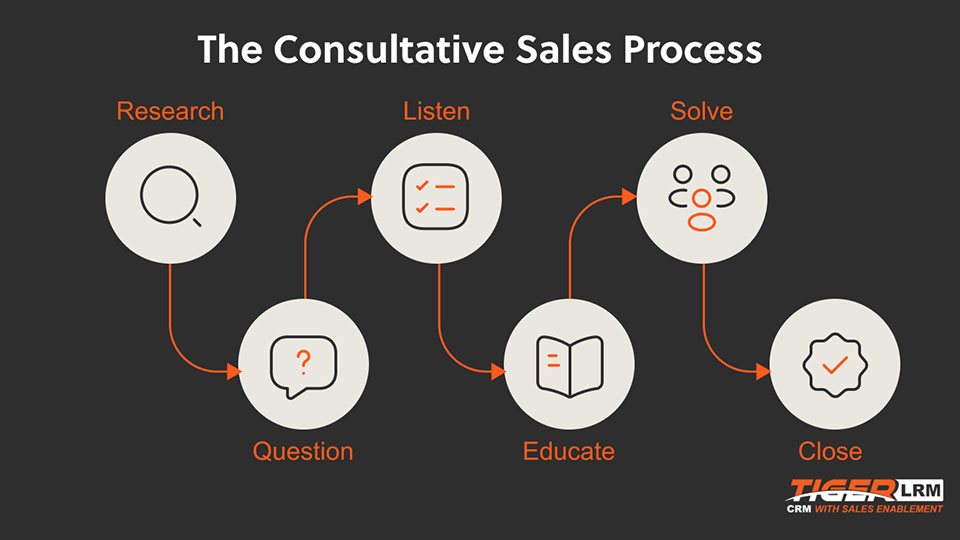
Let’s dive into each of them in more detail below.
Research
Research is the first step in the consultative sales process. Your reps need to understand as much as possible about their prospects before they start talking to them.
There are a lot of things reps need to understand. Starting with the obvious, they must ensure prospects match any ICPs or customer personas you use. That means understanding the company's size, the prospect’s place in it, and anyone else involved in the buying process.
They also need to understand the company’s goals and potential roadblocks. This can help lead initial conversations and prove to prospects that you care about them from the beginning.
LinkedIn can be a goldmine for this research, but don't let reps stop there. Encourage them to check out social media pages (both of individual prospects and the company itself), news articles, industry reports, and B2B databases.
Don’t underestimate the importance of this first step. The quantity and quality of research separate top sellers from everyone else. It’s not that they spend more time selling; they spend more time researching. 82% of top-performing salespeople “always” perform research on prospects before reaching out.
Question
The research phase doesn’t stop when prospects pick up the phone. Instead, reps must ask open-ended questions to understand better the customer's needs, aspirations, and pain points.
Some good questions to try include:
- What is stopping your company from achieving its goals?
- What solutions have you tried to solve this problem?
- How valuable would a solution be to your company?
Reps can also encourage prospects to expand with questions like:
- Would you mind telling me more about that?
- Are there any other examples you can share?
Remember, it isn't about interrogating the customer but facilitating a conversation encouraging potential customers to share their insights.
Listen
Gartner estimates that B2B buyers only spend 17% of the total purchase journey with sales reps. Your team has to make every minute count, and they can do that by actively listening to prospects.
Active listening is crucial in consultative selling. Reps need to genuinely hear and understand what the customer is saying — that means being patient and allowing the customer to express their thoughts fully without interruption.
This can be hard to coach, so sales intelligence and coaching tools are valuable. If you have a solution that lets you listen back to and evaluate your reps' calls, use it to check whether reps spend most of the call listening or talking. Doing this alongside reps is helpful so they can see how much they speak over prospects.
If reps are still struggling, a good tip is to have them repeat what they've been listening to. Repeating a conversation in their own words can prove to both parties that your reps have been actively listening. It will also avoid any miscommunication.
Educate
Having gained a deep understanding of the customer's situation, the next step is for reps to educate customers about potential solutions.
What they shouldn't do is launch into a sales pitch. Instead, they should share knowledge and insights about the wider industry that help prospects make informed decisions. Nor should reps dish out the same spiel to every customer. Instead, have them tailor their advice to the customer's level of understanding and interest. They can use examples, stories, or analogies to make complex concepts more relatable.
Reps shouldn’t be frightened of challenging a buyer’s preconceived ideas — that’s the point of education. Almost nine in ten buyers state they’re more likely to choose a company that changes their thinking.
Solve
Build a customized solution based on everything you’ve found out. Make sure to qualify prospects first.
Your reps are nearly ready to close the prospect, but first, they must design a customized offering that solves the customer’s problem. Make sure they base their solution on the customer’s pain points and show how your product can solve their specific challenges.
While it's important to clarify that you are providing a personalized service, it can also help show prospects how you have solved similar problems for other companies. Reps shouldn't just be sending over case studies and testimonials, however. Instead, discuss how you personalized your service to solve each customer's problem. Tailoring your offering is almost as important as solving the problem itself.
Close
When your reps have done consultative selling well, closing should happen naturally. They will need to continue listening and answering questions, but if they’ve proven that you can solve their specific needs, there should be many hurdles when signing the contract.
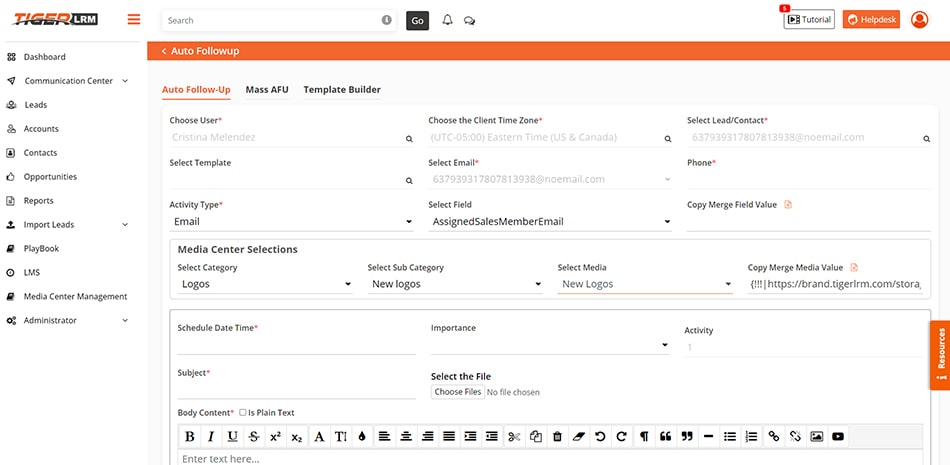
However, that doesn't mean your reps don't need to put in effort. They will still need to actively follow up with prospects to get the deal over the line. These busy professionals have more important tasks than buying software, which is why automating parts of the follow-up process so reps remember to stay in touch can be valuable.
Consultative selling best practices
Your reps must do more than follow the six-step process above to be effective consultative sellers. Encourage them to follow these best practices to stand apart from the competition.
Be authentic
Authenticity is the cornerstone of consultative selling. When your reps appear genuine in their interactions, it builds trust and credibility with customers — two things that are essential for forming long-lasting relationships.
You can't teach a sales rep to be authentic. But you can encourage them to care about their customer's needs as much as they care about their commission and to demonstrate integrity in their interactions. That means not overpromising or overselling just to make a sale.
Instead, encourage reps to present their solutions honestly, highlighting strengths and potential limitations. This approach can differentiate you from competitors and foster a sense of trust with your customers.
Gather feedback
Feedback gives your reps insights into the customer experience, helping them understand what worked and what didn't in the consultative selling approach.
Encourage reps to regularly ask customers for feedback on their interactions and your solutions. This could be through informal conversations, surveys, or structured feedback sessions.
Your reps should be open to constructive criticism and ready to make changes based on the feedback they receive. Remember, consultative selling is a learning process, and feedback is a valuable tool for continuous improvement.
Leverage your CRM
Top-performing sellers are twice as likely to use sales technology every day. Your CRM system can be a powerful ally in the consultative selling process. A robust CRM system can store detailed information about each customer, including their preferences, previous interactions, purchase history, and feedback.
Your CRM data can help reps tailor their approach to each customer, enhancing their ability to understand their needs and offer personalized solutions. Moreover, CRM systems can provide insights into customer behavior and trends, allowing reps to anticipate customer needs and be proactive in their consultative selling approach.
Become a consultative seller with TigerLRM.
A consultative sales approach is one of the best ways to serve the modern B2B buyer who is willing and able to do their own research. It replaces the antagonistic traditional sales approach with a softer, collaborative one where everyone can win.
But consultative selling doesn’t always come easy to sales reps. Your business needs a tool that empowers reps to provide a consultative service to customers (like following them up regularly) and also provides a playbook they can follow.
TigerLRM’s free sales enablement & CRM platform was designed by sales leaders to do all this and more. Create and host a personalized playbook with consultative selling at its core, use the platform’s learning management systems to increase adoption, and give reps simple-to-use tools to automate parts of the consultative selling process.
Get in touch to learn more about how TigerLRM can help you breed consultative sales, or sign up today.

How to assign a user to become a sales enablement professional in your TigerLRM Dashboard.
To assign a sales enablement user, simply go to Administrator > User Management > Edit User.
Once you are on the user's information, you can select if you want them to be "Non-Admin," "Admin," or part of the "Enablement Team." Save this information, and your desired user will have the right access.
You can access your Dashboard here.